
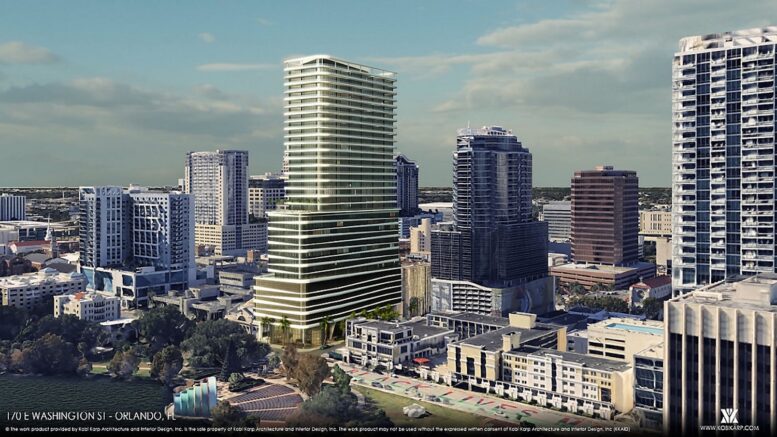
Plans have been filed for a 37-story, 425-foot mixed-use tower on a 0.63-acre site at the corner of East Washington Street and North Rosalind Avenue in Downtown Orlando. The proposal, submitted on March 23 by HB Capital Group, calls for a high-rise development designed by Kobi Karp Architecture & Interior Design and represents the latest attempt to redevelop one of the city’s most closely watched vacant parcels across from Lake Eola Park.
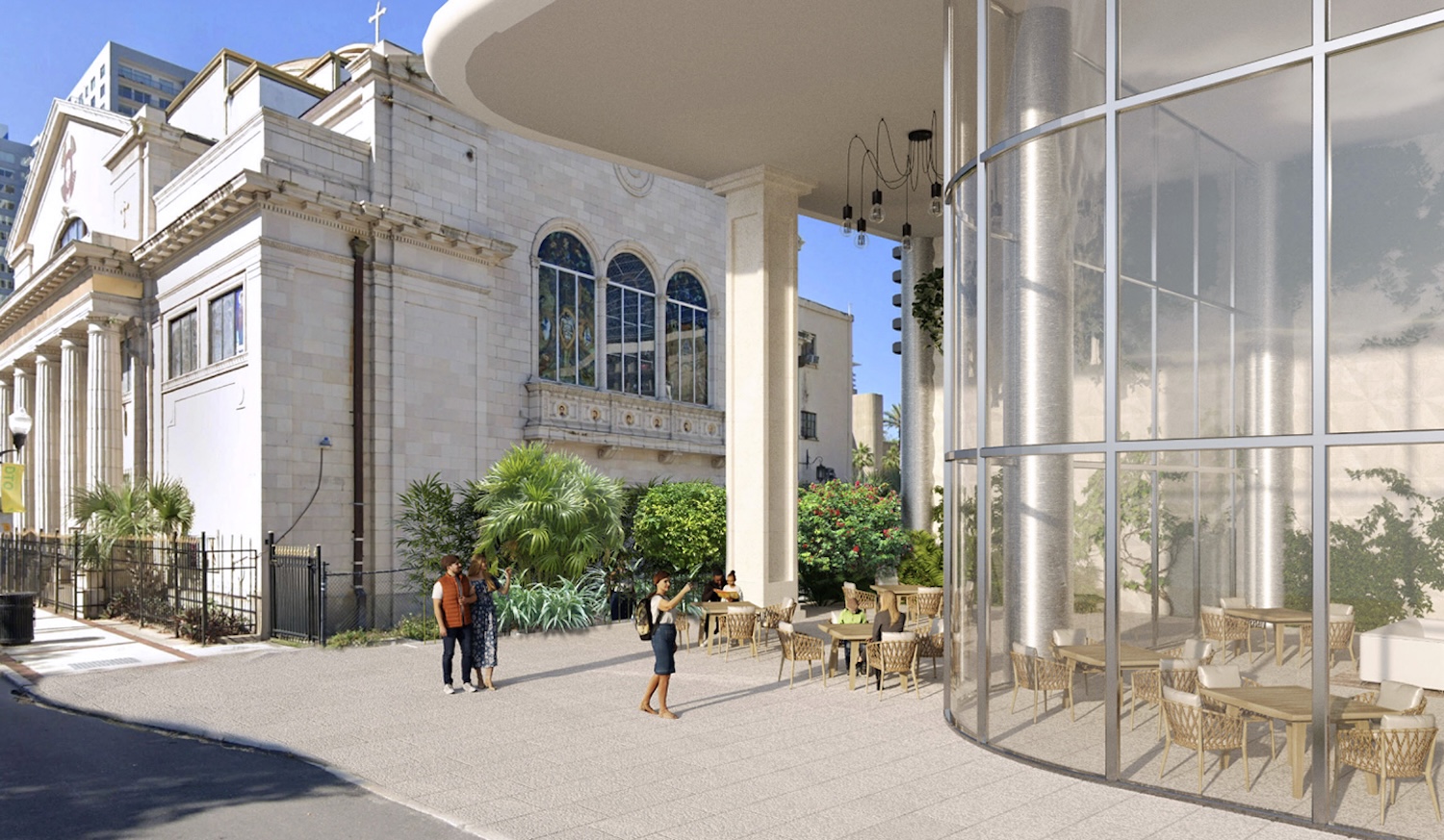
The development is planned to include up to 252 condominium units, a 221-room hotel, approximately 35,000 square feet of commercial space, and six levels of structured parking. Plans also call for a ground-floor restaurant with outdoor seating facing the park, while the hotel pool deck is positioned to overlook the water.
Credit: Kobi Karp Architecture & Interior Design.
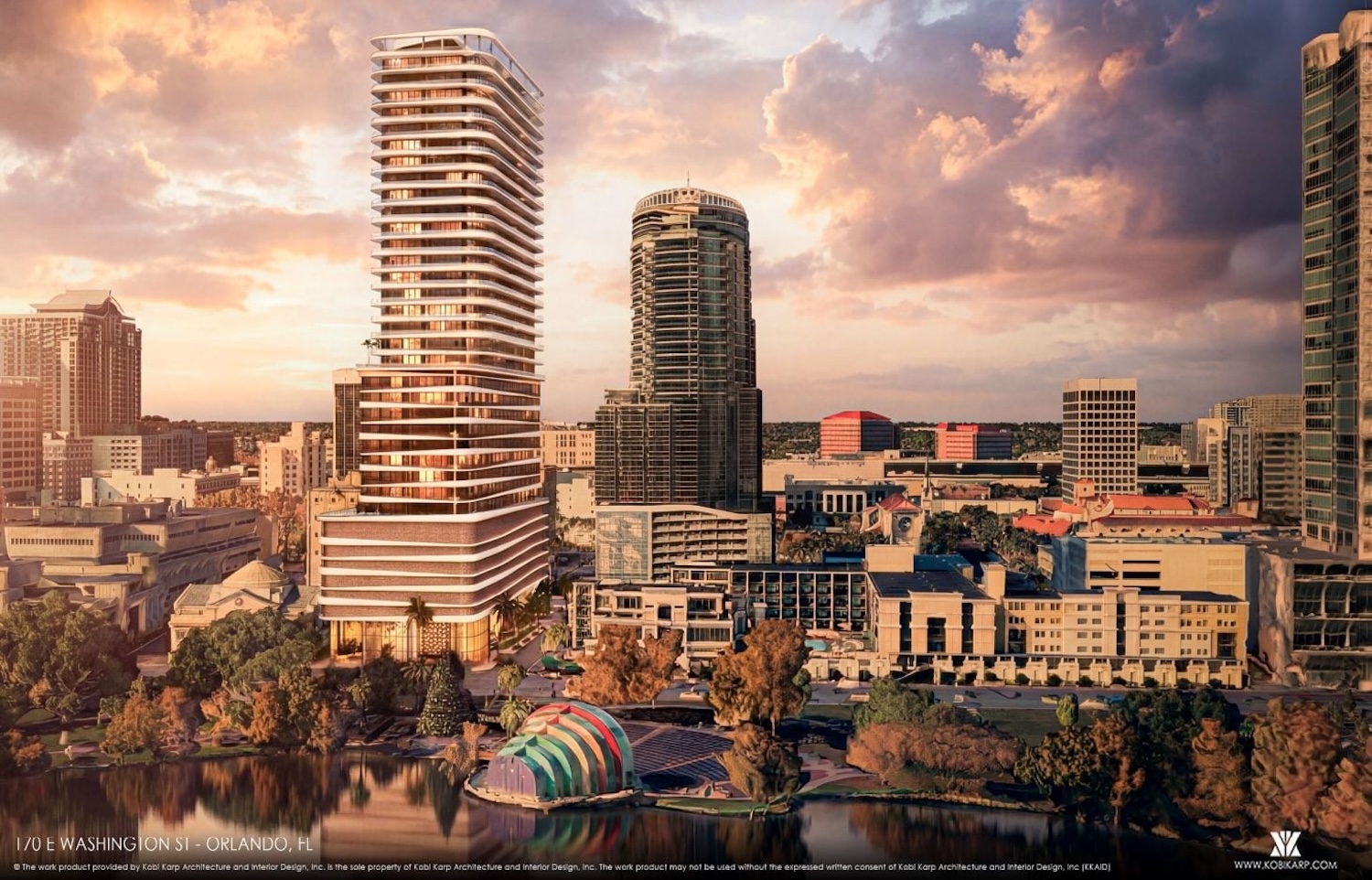
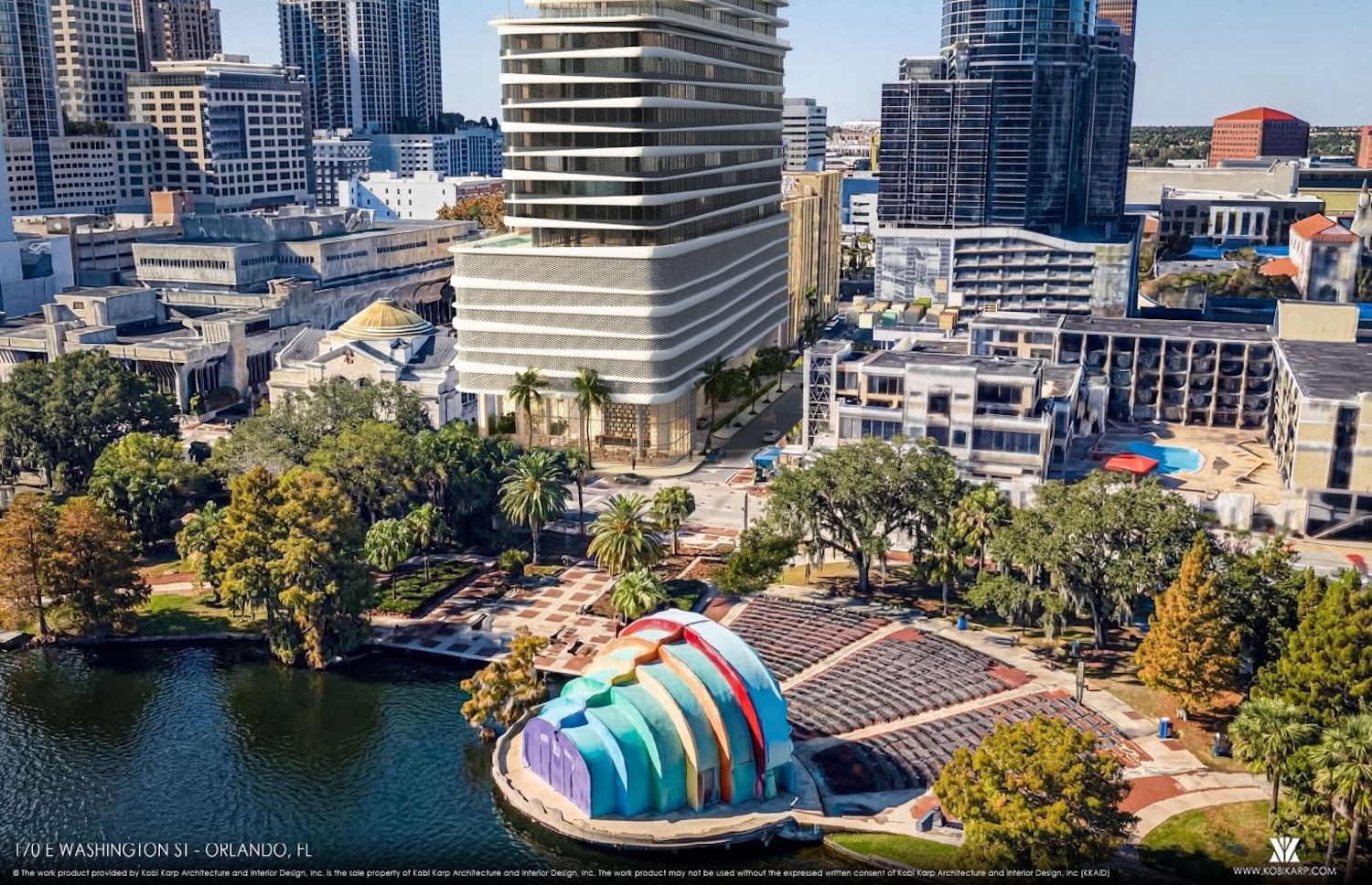
Kobi Karp’s design organizes the building into three volumes with two setbacks and distinct façade treatments. At street level, storefront glazing anchors the base, above which the parking structure is screened by white elongated trapezoidal horizontal bands with what appears to be a metallic or aluminum mesh infill between them, integrating the garage into the overall façade. At the ground floor, at least one column appears clad in a material sympathetic to the neighboring St. George Antiochian Orthodox Church, a subtle contextual gesture at the point where the two buildings meet most directly.
Credit: Kobi Karp Architecture & Interior Design.
Above the podium, the horizontal banding expressed at each slab edge appears to be driven more by surface treatment than by physical projection. The renderings indicate a two-tone approach in which a white finish is applied in an angled, trapezoidal pattern, while the remaining finishes are expressed in a darker, near-black tone. The fenestration consists of floor-to-ceiling glass panels set within this contrasting framework, allowing the banding to read clearly across each level.
At the residential levels, the white bands appear to be a composite expression formed by a combination of angled balcony glass and the adjacent trapezoidal banding. This layered approach reinforces the continuity of the façade, with balcony edges and painted surface treatments working together to create the visual effect of continuous horizontal ribbons wrapping the tower.
Credit: Kobi Karp Architecture & Interior Design.
The crown is defined by a continuous horizontal band, or concrete eyebrow, that wraps the uppermost level, likely screening the mechanical enclosure or elevator bulkhead while providing a clean termination to the composition.
If built, the project would rank among the tallest buildings in Downtown Orlando, comparable in height to The VUE at Lake Eola and the Orange County Courthouse. The proposal would also introduce the first branded residences, luxury condominiums tied to a hotel brand, to the city’s central business district. No hotel brand has been announced.
HB Capital Group, based in Sunny Isles Beach and led by CEO Steven Hurowitz, acquired the property in 2018 in partnership with Stratus Development Partners for approximately $3 million, with initial plans for an eight-story, 155-room Cambria Hotel. That proposal received design approvals and underwent multiple revisions but was never constructed. Stratus Development Partners has since exited the venture, while HB Capital Group has retained control of the site. The 0.63-acre parcel has remained vacant since at least 2017, surviving three rounds of Cambria Hotel design approvals, a pandemic, and a 2023 exploration by Lincoln Property Company, the developer behind Truist Tower, that was withdrawn before a hearing.
The current plans represent a substantial increase in scale and density. Architectural drawings dated March 10 depict two alternate development scenarios, including a residential and hotel configuration and a residential and office version. A traffic study prepared by Luke Transportation Engineering Consultants indicates that both options would generate comparable impacts. The application also seeks to modify the city’s definition of “substantial change” from 10 percent to 20 percent, allowing for greater flexibility in future design modifications without requiring additional public hearings.
City planning officials have indicated support for the proposal, citing continued demand for residential development and a relative shortage of hotel rooms in Downtown Orlando. The tower’s proposed height of 425 feet aligns with Federal Aviation Administration constraints tied to nearby flight paths serving Orlando Executive Airport.
The proposal is scheduled for a hearing before Orlando’s Municipal Planning Board on May 19 at 9 a.m. No construction timeline or estimated cost has been disclosed.
Subscribe to YIMBY’s daily e-mail

Follow YIMBYgram for real-time photo updates
Like YIMBY on Facebook
Follow YIMBY’s Twitter for the latest in YIMBYnews
Even a blind person would know this parking podium box is not “sympathetic” to its neighboring buildings, or a streetscape for that matter.
It seems developers and architects try to find the cheapest, most unimaginative way to give their buildings any distinction. I would love to see a return of classic architecture, but…..
It doesn’t even have to be classical, because good, modern architecture is able to be inoffensive… for example, not having an obvious parking podium taller than surroundings buildings that aren’t going anywhere anytime soon.
True. There’s a lot of really beautiful modern stuff, too. Having a mix of both styles in ways they compliment each other would be best. But the local governments and developers just don’t care, apparently. Downtown Orlando could’ve been so much better.